


In Michigan, Jewish Democrats have found themselves in a pickle—and not the delicious kosher dill kind, but a kind of, sort of antisemitic pickle.
Michigan’s closely contested Senate race between charismatic progressive — and fiercely antizionist — Dr. Abdul El-Sayed and Trumpublican Mike Rogers has presented Jewish Democrats with an agonizing dilemma few have faced elsewhere in the country, made all the more difficult by the possibility that the outcome could determine which party controls the Senate.
Needless to say, the majority of Jewish Michiganders have not exactly felt welcomed by his campaign with his relentless focus on U.S. aid to Israel and lack of understanding about Jewish security concerns.
If elected, El-Sayed would make history as the first Muslim to serve in the Senate. In 2022, another Muslim physician nearly broke that barrier when Dr. Oz lost to John Fetterman in Pennsylvania.
With less than three weeks until Election Day on November 3, El-Sayed holds a narrow lead. As of October 14, the RealClearPolling average puts him ahead by about 3 points; Polymarket gives him a 67% chance of winning.
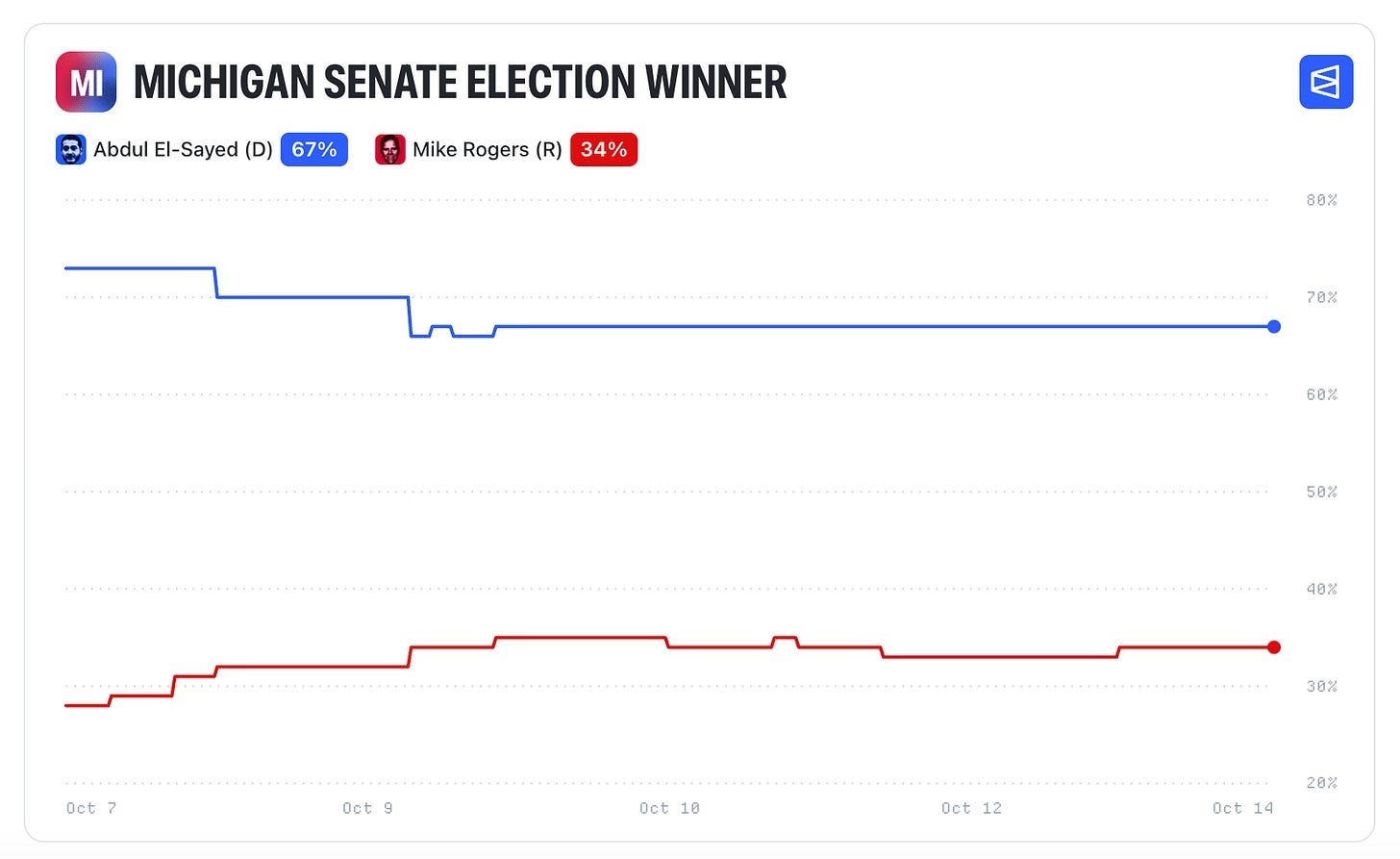
Since the early 20th century, American Jews have been among the Democratic Party’s most dependable constituencies. Now, many Jewish Democrats are wondering whether the party still values their votes.
The Nonnegotiables
The growing frustration has inspired a coalition of Michigan rabbis and Jewish leaders to launch a last-ditch effort called Nonnegotiable Michigan, calling on Democratic party leaders and candidates to affirm five basic principles:
Jewish safety — yes, including for Zionist Jews
Jewish self-definition — Jews get to decide what being Jewish means, not politicians and activist gatekeepers.
Jewish sovereignty in Israel — The Jewish majority in the world’s only Jewish state deserves the same legitimacy and respect afforded to other nations.
Full participation in American political life — Jews deserve a seat at the tables we helped build without having to renounce our Zionism or Jewish identity.
An affirmative vision for peace in the Middle East — Concrete plans, not catchy slogans. Calls for “one democratic state” between “the river and the sea” are often coded language for eliminating Israel’s existence as a Jewish state rather than offering a coherent, feasible plan for peace and resolution.
As the campaign site says, “The positions above are the floor.”
Notably, this movement is not endorsing a candidate.
Its message is simpler, and more important: “Support must be earned, not owed.”
El-Sayed’s strained relationship with Jewish Michiganders took a particularly ugly turn after the March terrorist attack on Temple Israel, where a gunman drove a truck loaded with gasoline and fireworks through the synagogue, past a nursery where infants slept and toward a gym where children played. Inside, 103 young children and nearly 50 teachers, clergy, and staff members narrowly escaped what could have been a massacre, thanks to the synagogue’s security team.
El-Sayed initially condemned the attack, but then invoked the deaths of the assailant’s family in an Israeli airstrike in Lebanon, saying, “Hurt people hurt people.” For Jewish parents whose children had just fled a burning synagogue, it sounded less like solidarity with the victims than sympathy for the man who tried to murder them. Months later, El-Sayed apologized, but his explanation hardly reassured critics: he suggested the problem was his timing, insisting that “there is opportunity for context later on.” By then, the damage was already done. In September, a Temple Israel leader estimated that roughly 70% of congregants would vote for Republican Mike Rogers.
The attack transformed what might otherwise have remained an abstract argument about political rhetoric into a matter of life and death. For many Jewish Michiganders, this revealed Abdul’s callous disregard for Jewish vulnerability here in America.
In Olivia Reingold’s reporting for The Free Press, Eddie Rubin, a lifelong Democrat whose two children were inside the synagogue during the attack, described feeling politically homeless. He supports liberal causes but cannot bring himself to vote for El-Sayed. Nor does voting for Rogers, a Trump-backed Republican, sit comfortably with him.
“I feel like I have no home and no party,” he said.
Consider Michigan Attorney General Dana Nessel, a Jewish lesbian Democrat and longtime LGBTQ rights champion who made history as Michigan’s first openly gay statewide elected official.
In August, she told David Frum of The Atlantic that antisemitic hostility within her own party had become so troubling that she was skipping its state convention.
A month later, she endorsed El-Sayed anyway.
