


The first thing I noticed about Rachel Goldberg-Polin's debut memoir, When We See You Again, is that there are no blurbs on the cover. In publishing, even a first-time author with 12 Twitter followers has at least one blurb heaping praise. Goldberg-Polin, who has met essentially every world leader and spiritual figure alive since the abduction and murder of her 23-year-old son, Hersh, by Hamas, has none.
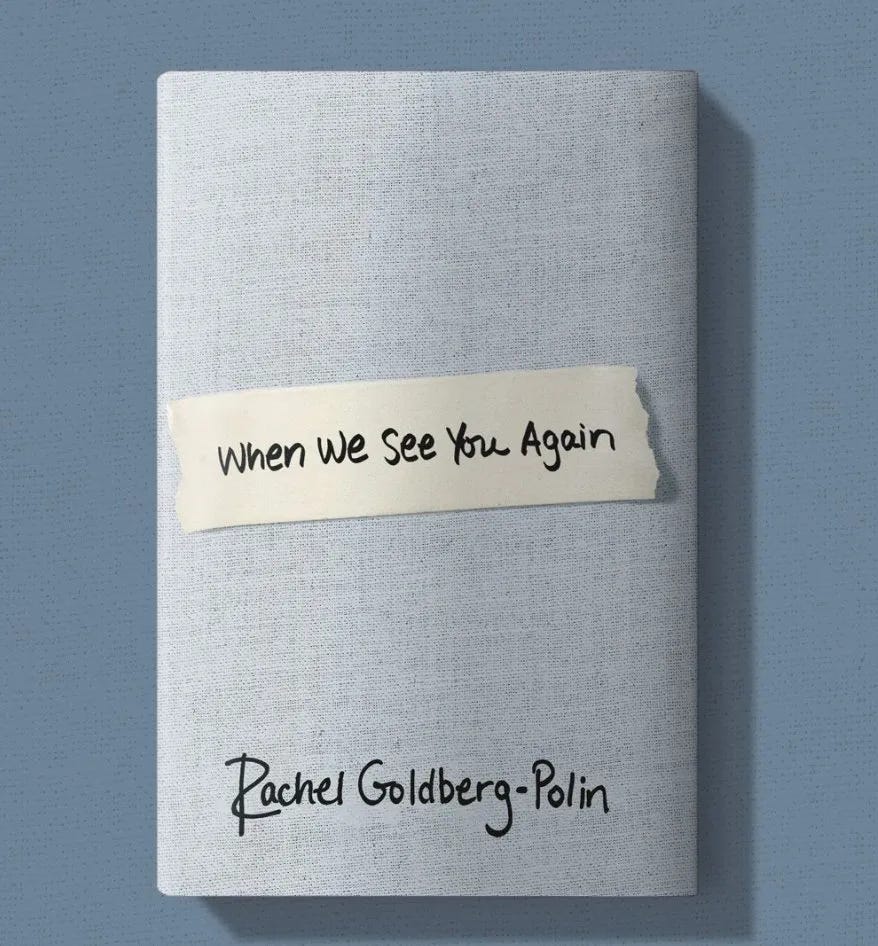
Her bio on the back cover flap is equally spare. It simply says, “Rachel Goldberg-Polin, born and raised in Chicago, is an educator who lives in Jerusalem with her husband, Jon. They are the parents of three children.”
Anyone else with her same profile would’ve mentioned that she was one of Time 100’s most influential people of 2024 and one of USA Today’s Women of the Year for 2026.
That she chooses none of that tells you the kind of person she is.
To understand how singular Rachel Goldberg-Polin's place in the Jewish world has become since October 7th, you have to first accept that there is really almost no one like her who has ever existed. She’s both a symbol of collective grief and a figure akin to the world’s Jewish mother. And because she speaks with such poetic composure in her interviews and speeches, she often registers more like a spiritual figure. Remarkably poised and apolitical, her message has always been about the love for her son and never strayed into the frayed territory of the conflict itself. The empathy she shared for Palestinian loss of life in Gaza is notable given the level of anguish she’s endured. It would be easy to have rage, yet she has none.
My friend calls her the “Jewish Mother Teresa.”
Perhaps the closest parallel to her is Mamie Till-Mobley, whose son Emmett Till’s horrific murder in 1955 helped spark the civil rights movement. Like Till’s mother, Rachel has never stopped speaking out. They both understood that their grief was not only theirs. By sharing the stories of their sons, they belonged, in some way, to everyone who cared to listen. Rachel says Hersh proves that you don’t need to know someone to love them. That is true. Much of the Jewish world was in shock and grief when news of his death was announced in 2024.
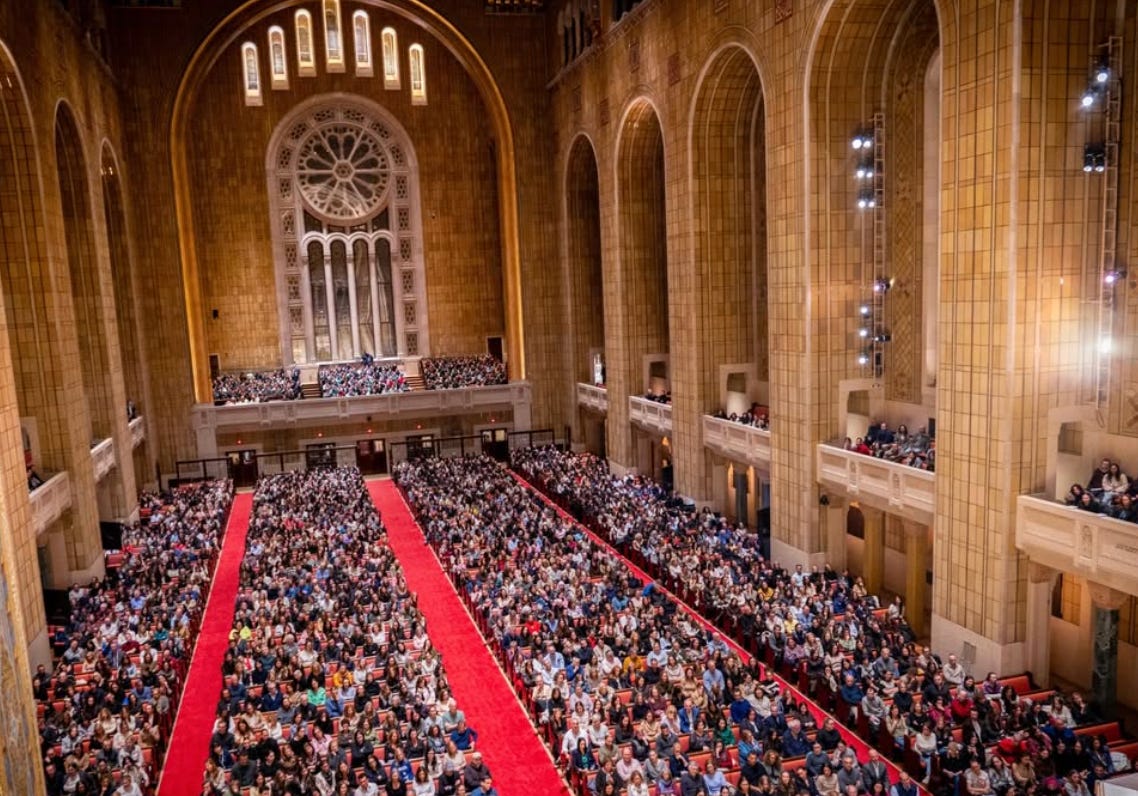
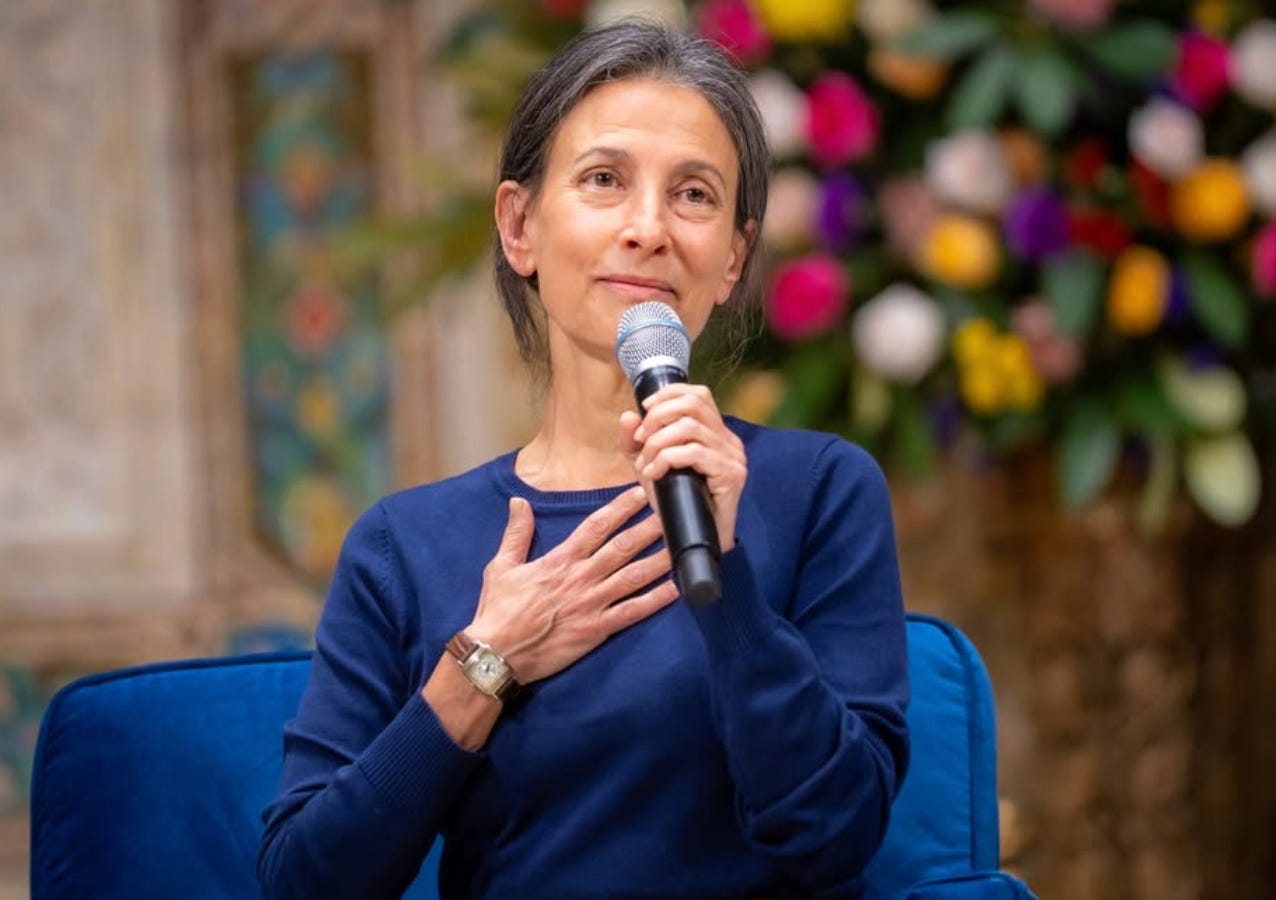
On Monday night, I went to her book launch at Temple Emanu-El, joined by over 2,000 people in the main sanctuary. Even Jerry Seinfeld was there. It was so packed it felt like Yom Kippur. It felt like Yom Kippur in other ways, too.
When I got home from the event, I stayed up until 2 am reading half the book, which for me is saying something. I'm usually asleep before midnight without much question. I finished the rest over the next two days. It is the kind of book that just unfolds before you.
With this book we get a fuller picture of who Rachel and Hersh are. She describes it as a “love story wrapped in pain” or maybe a “pain story wrapped in love.”
For the past two and a half years, Rachel has been one of the most recognizable faces of the hostage crisis — a mother who showed up at every rally with a piece of tape over her heart that bore the number of days of captivity. She somehow remained a figure that people across the political divide could point to. Somehow, impossibly, she has remained untouched by the gravitational pull of politics.
People who agree on nothing else agree on Rachel.
She speaks of her life as divided into two parts: The Before and The After. Dan Senor, who moderated her book launch, called her one of the most illuminating voices in modern Jewish history, akin to Holocaust survivor Elie Wiesel. He’s not wrong. But it doesn’t fully capture what we’re actually witnessing.
She describes herself as not being fully part of this world anymore. She’s not being metaphorical.
There is a mystical, spiritual quality to her that is difficult to explain without sounding too woo-woo. Her trauma and loss have jolted her into a different relationship with reality than most of us will ever understand. She lives, as she puts it, in The After. And The After, it turns out, is basically a different plane of existence entirely.
She says the moment she buried Hersh, a part of her got buried too. I did some Googling. In Judaism, there’s a concept that supports this idea: karet — being “cut off.” When a child dies, a piece of the parent’s soul goes with them. The parent is literally incomplete in a metaphysical sense, not just emotionally. They are a partial soul walking around.
When she speaks, you feel the distance between where she is and where the rest of us are standing. It’s like we’re not on the same planet. She’s been cracked open so deeply, a certain light shines through her that most of us will never grasp. Her pain and wisdom are linked, and despite everything, she remains incredibly grounded in her beliefs— or as she says, what she knows.
She became mythologized as this strong, resilient person. But she doesn’t view herself that way. In the book, she writes, “People want hope, resilience, recovery, strength, survival, healing. They want thriving and rising from the ashes like the phoenix from the days of yore. But the pain is chronic, ever-present, constant. Gnawing. Circular, not linear.”
One can only wonder what this book would’ve been like had Hersh come home alive and they co-authored one together. What their speaking tour would’ve been like. A celebratory hero’s welcome. Both of them explaining what it felt like from their respective sides of the same impossible situation. The version where the story has a feel-good ending.
Rachel believes strongly in fate. She believes, that for whatever reason, Hersh was always going to die in those tunnels on day 328. That it was destined. That no amount of advocacy or prayer or negotiation was ever going to change the ending, because the ending was already written from the day he was born.
She says, “You cannot outrun your destiny.”
I had to re-read that section twice to make sure I wasn't misreading her. I wasn't. She doesn't merely believe this. She says she knows this with the same certainty as looking at a glass of water and knowing water is wet. She doesn’t know why— she’s on a quest to find that out— but she knows that it was meant to be.
It’s a hard concept to wrestle with. If everything is fated from birth, then human choice is an illusion. This philosophy would almost make you seem passive, but Rachel was the opposite: she spent 328 days fighting, advocating, traveling, and pleading, as if her actions could change the outcome. If it was always fated, why fight? Her answer, implicitly, seems to be: because the fight was also fated. Because “hope is mandatory” regardless of outcome.
She also writes that the 4 am knock on the door from the “messengers of death” who delivered the news was the closest she ever felt to god.
She’s certainly not at peace, and she makes clear in her writing that she’s much more wrecked than people even realize. She describes herself as an actor in public. But she has also mastered the art of “yes, and.” She carries her grief as a badge of loving honor and says it doesn’t mean there aren’t still moments of joy and humor. It’s just that every moment is seared with pain like a chronic condition she will live with for the rest of her life. She's spoken to other parents who have lost children, and they have all told her the same thing: it will never get better. She finds comfort in that even if the American Psychiatric Association would classify her as disordered. The DSM was updated in 2022 to include Prolonged Grief Disorder as grief lasting more than 12 months. Rachel finds this fitting, actually. A child dying before their parent is, by definition, out of order. Of course the grief that follows is disordered. What else would it be?
She has no interest in being healed or moving on. She accepts, fully and without apology, the label of being broken.
Surprising New Details
One of the most extraordinary discoveries to emerge since Hersh's murder was Rachel's meeting with Or Levy, a fellow hostage who had spent parts of the first 54 days with Hersh in the tunnels. When Or was released, he sought out Rachel immediately. He had things to tell her that he needed her to know.
The first was this: Hersh knew his parents were fighting for him. He knew because one of his captors had a radio, and one day he heard his mom talking about meeting with the Secretary of State. The level of miraculous that is. And the miracle that Rachel now knows that Hersh knew because of a surviving hostage. That gives me chills.
Or (whose name is Hebrew for ‘light’) also told her something else. In the tunnels, Hersh had convinced his captors to bring him something to read. Rachel describes him as a voracious reader incapable of existing without a book.
He was given Shadow and Bone, a YA fantasy novel by Leigh Bardugo, popular primarily with young girls on TikTok. Bardugo is Jewish, by the way. A Jewish author's fantasy novel circulating in a Hamas tunnel is its own remarkable detail. Make of that what you will.
Hersh read it. Then he read it again. Then he read it aloud, creating a kind of book club in the tunnels. On day 54, he was moved to another location — he, Ori, and Almog were told they were being freed, which was a lie. Before he left, he gave the book to Or. Or left it on day 491 for Eliya. Eliya left it for Alon, who was released on day 505. Alon had been the last of that original group remaining underground until day 738.
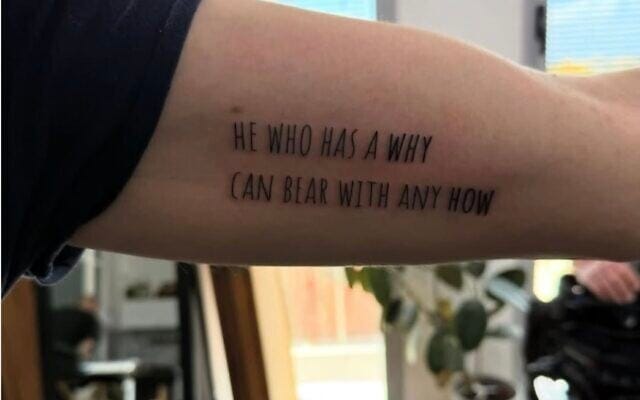
Hersh was also quoting Viktor Frankl’s Man’s Search for Meaning in the tunnels: “He who has a why can bear with any how” became the mantra for the other hostages. Or Levy got it tattooed on his arm after he was released.
Other Details That Floored Me
Rachel recently discovered a journal entry Hersh wrote in October 2015 when he was in 9th grade. In it, he speaks of being in life’s “tunnel.” He uses that word 12 times. Here’s part of it: “To every person there is a tunnel that belongs to them. Some have small tunnels and some have long tunnels. What is certain is there is an end…Who knows how many more tunnels I will encounter…But whatever comes my way, it won’t stop me…What is sure is that I am walking to the end of the tunnel.”
Rachel read Kurt Vonnegut’s Slaughterhouse-Five to Hersh when he was in 5th grade. You know, the one about a prisoner of war who becomes unstuck in time. The book is equally about what the mind does when it has witnessed something it cannot process in linear sequence. It is about a man who is present and absent simultaneously, here and somewhere else at once, alive and already knowing how he will die.
Since October 7, Rachel had not seen either of her parents until they arrived for Hersh’s funeral in Jerusalem.
The last book Hersh read before Oct 7 was The Art of Happiness by the Dalai Lama.
Hersh’s birthday is Oct 3. Rachel’s Oct 12. I didn’t know that until reading the book and somehow the proximity of celebration with horror adds an extra layer to this story.
Other Random Details That Were Interesting
She describes Hersh as “the only vegetarian I know who ate no vegetables or fruit. People used to say, “what about corn? What about potatoes? What about grapes?” No, I said. No vegetables or fruit.”
Hersh had a photographic memory and by age 6 knew all of the Presidents and their wives and other random minutiae.
She takes inspiration from The Shawshank Redemption, saying Andy Dufresne “uses the tiniest of tools to scratch at the wall that stands between him and his freedom. It takes years, but he finally succeeds…I have never been strong. I’m not being humble. I’m being truthful. Now it’s all I want. I’ll get there. Like Andy Dufresne.”
At age 4, she took her first solo flight to visit her grandparents, flying about 45 min from Chicago to Detroit.
In the summer of 2023 Hersh had travelled Europe on a “mini-trip” visiting music festivals to prepare for his “big trip,” a 2-year solo adventure to India he had planned since his Bar Mitzvah. He already had a one-way ticket booked for December 27th to Goa — the jewel of the Indian coastline, a sun-drenched beach city of palm trees and turquoise water that draws young travelers from around the world the way Miami draws everyone else.
There’s lots of other rich details here. I’ll leave you with a personal one that shows how interconnected we all are.
I had known that before Rachel and Jon moved their family to Israel, they lived in Richmond, VA for a few years. My family lived there too, from 2005-2008. A few years ago, my mom had mentioned that she felt like she had met Rachel before. Well, it is confirmed in the book that Rachel worked at the Richmond JCC as an adult educator from 2004-2008. Given how small the Jewish community of Richmond is, that pretty much confirms my mom had likely seen Rachel at the gym and in the halls on multiple occasions.
Our lives are so interwoven without even knowing it.
Thank you for sharing your powerful Rachel Goldberg experience. I hope her writings and talks lead us to something bigger, a movement, to help heal our broken and divided society.
Such a special woman she is.