


This piece was originally co-written and published on Patrick Murphy’s Substack. I’ve reposted a lightly edited version here for my own audience to read and share. (Apparently, doing a joint byline on substack doesn’t send the post to the other contributor’s subscribers.) I hope you’ll give this one a full read.
Thanks, as always, for being here.
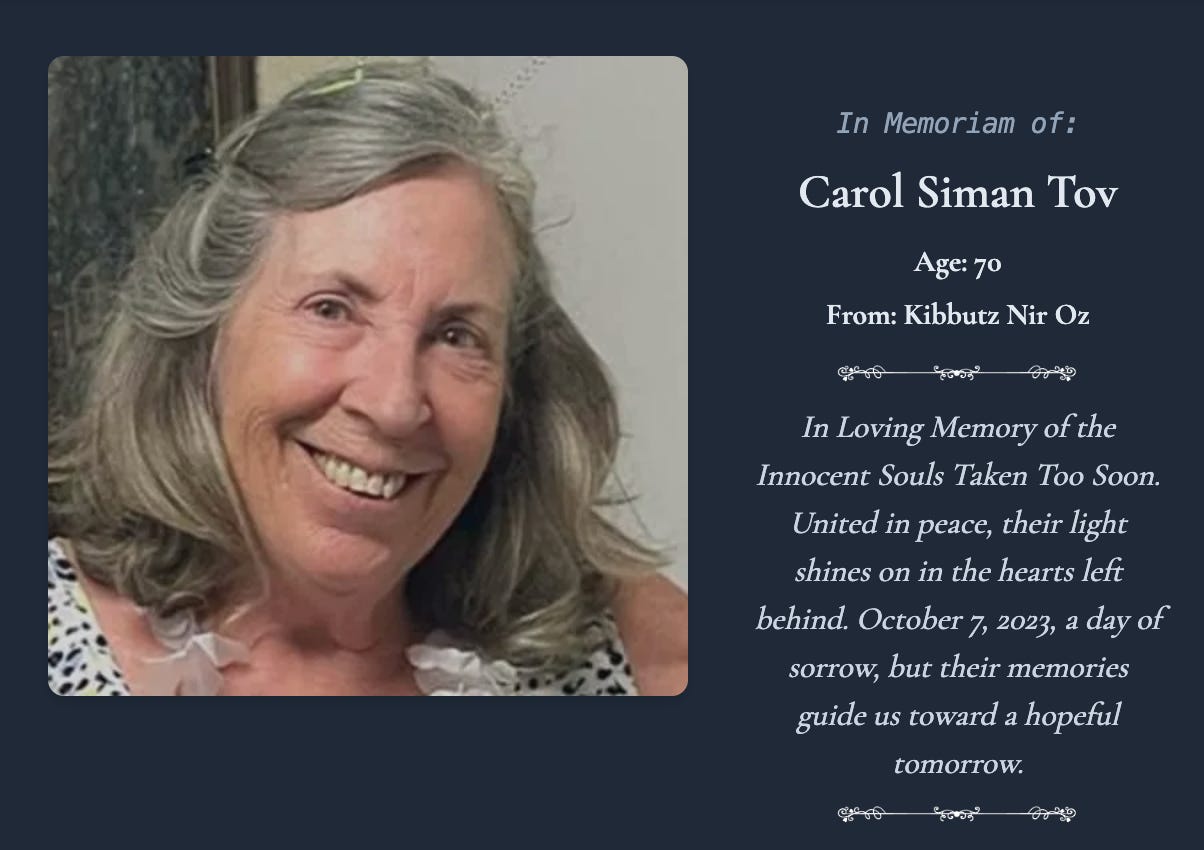
It’s been three years since the Oct. 7 massacre in which thousands of Hamas terrorists and other armed civilians poured across Israel’s southern border and carried out the deadliest attack on Jews since the Holocaust, killing roughly 1,200 people from over 30 countries, including 33 Americans, and dragging 251 hostages into Gaza. Among the hostages were 12 Americans and dozens of foreign nationals, including 31 Thai farm workers. One of those killed was Bucks County native Carol Siman Tov, a 70-year-old grandmother who had later built her life in Kibbutz Nir Oz. Carol was murdered in her home that morning. Nearby, her 36-year-old son Johnny was killed, along with his 35-year-old wife Tamar, their 5½-year-old twin daughters Shahar and Arbel, and 2-year-old son Omer. According to Johnny’s sister, the family was shot through a window as the house was set on fire.
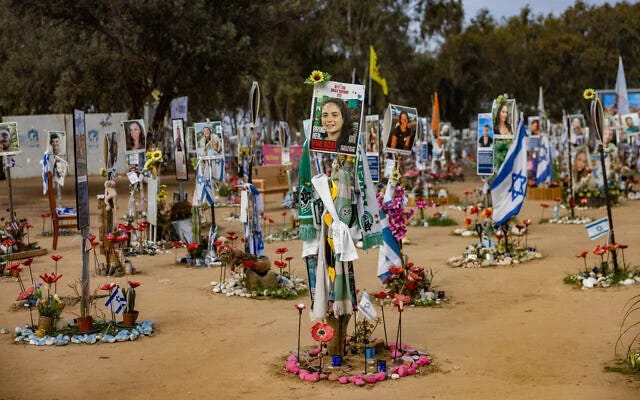
The scale of the attack is still almost incomprehensible in its cruelty. Families were burned alive in their homes, women were raped and mutilated, and 379 people were hunted down at the Nova music festival— billed as a celebration of peace and love. For perspective, Nova killed 6x as many people as the deadliest mass shooting in American history—also an attack on a music festival, in Las Vegas in 2017—which killed 60 people.
This year is more hopeful, as it will mark the first anniversary of the return of the remaining 20 living hostages who spent more than two years in Hamas captivity. Many of them were held in the squalor of underground tunnels for their entire capture.
Among those hostages released was Omri Miran, the brother-in-law of Moshe Lavi, who has become a friend I’ve made in NY. (You can find his newly launched Substack here.)
Moshe shared the following words with me:
For two years, October 7 never truly ended for our family, as our odyssey, and that of an entire nation, continued. Omri remained in Gaza, while my sister Lishay and their daughters Roni and Alma waited for him at home. This year, the grief and scars remain, but something fundamental has changed: Omri is home, our family is whole again, and after 738 days of fighting for his return, and 843 for the return of the last remaining hostage, we are finally learning how to live beyond October 7, rather than inside it.
While the release of the hostages closed one painful chapter, the political and humanitarian crisis left behind in Gaza remains an unresolved problem. What began on October 7 as an Israeli national catastrophe became a war that decimated Gaza and transformed the politics of the Middle East.
As we reflect on the third anniversary of this horrific tragedy, many will also rightly reckon with the scale of the response by Netanyahu’s Likud-led government and the devastation it has wrought in Gaza. More than 70,000 Gazans have been killed in the resulting war and nearly the entire population of its 2 million residents was displaced at some point, with more than 371,000 housing units damaged or destroyed. Rebuilding Gaza is now estimated to cost more than $71 billion over the next decade.
The political shockwave of this war has rippled across the Middle East and the Western world. American politics hasn’t been the same since. This has essentially become one of the defining political and moral fault lines of our time. Support for Israel—or opposition to it— has become a kind of ideological sorting mechanism. And for prominent Jewish politicians, it’s most glaring.
Since 2024, Governor Josh Shapiro of Pennsylvania has been smeared by some antizionist activists as “Genocide Josh”, an especially stupid nickname when you consider the minor detail that the governor of Pennsylvania does not control the federal budget or, last I checked, the IDF. The insult isn’t supposed to make sense, though. It’s an explicitly antisemitic slur to demonize the Jewish governor as having dual loyalty – an old and cheap trope that treats Jews as inherently suspect to whatever country they belong to. Governor Shapiro has repeatedly criticized Netanyahu, calling him “one of the worst leaders of all time” in 2024 and in 2025, demanding more humanitarian aid for Gaza.
Those kinds of targeted slurs against Jewish leaders have ramifications. We saw that in 2025, when Shapiro’s official residence was firebombed on the first night of Passover. The arsonist did so in the name of Gaza. It bears repeating that an American governor has exactly zero authority over American foreign policy.
One can argue politics all day. What is much harder is to find the appropriate action moving forward.
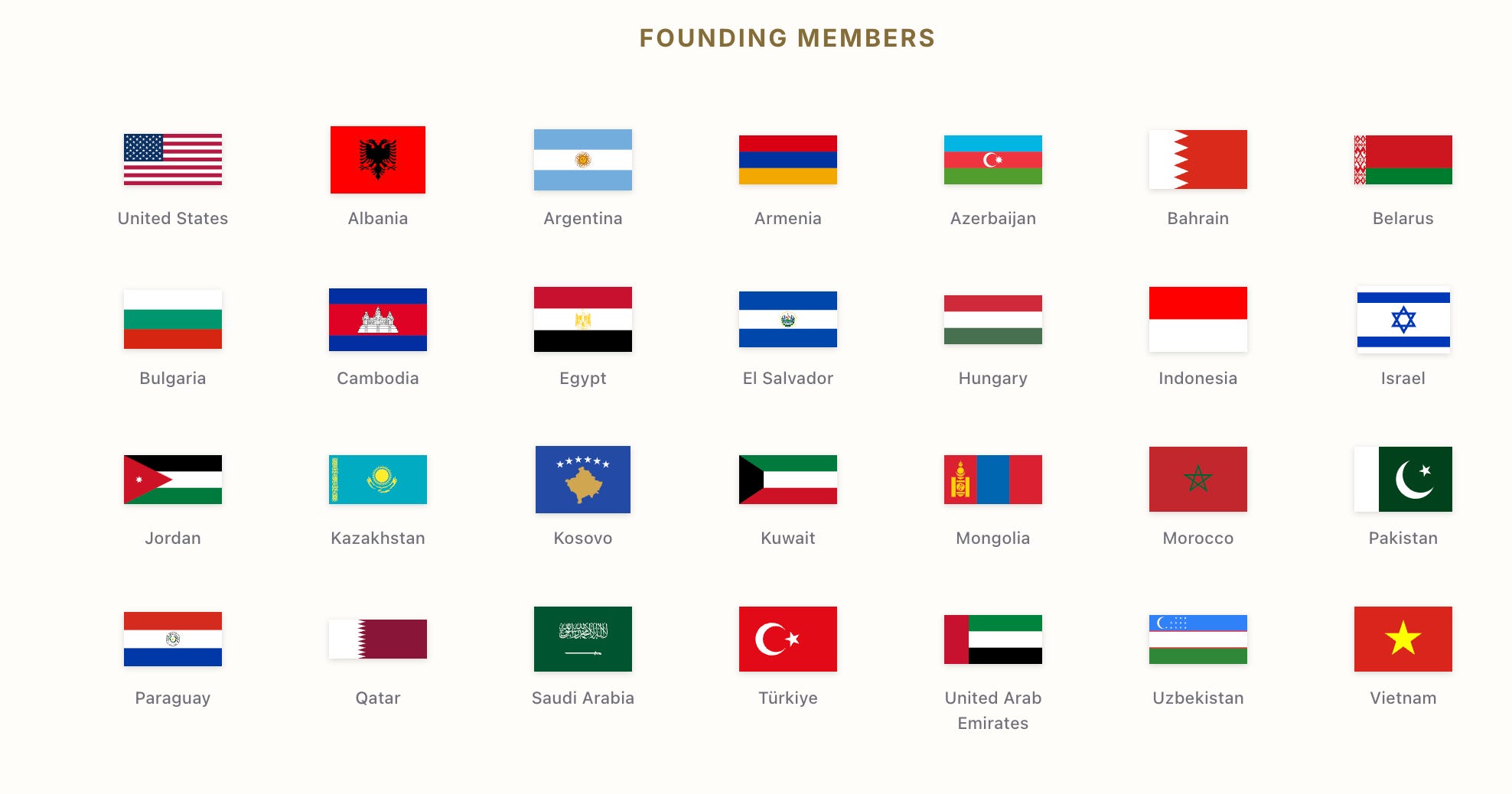
As part of the 2025 negotiations to end the war in Gaza and return the hostages, President Trump proposed an ambitious 20-point plan backed by a ‘Board of Peace’ with over two dozen founding countries. This independent entity was meant to oversee Gaza’s postwar transition pairing a Palestinian technocratic government with an International Stabilization Force (ISF) with a phased Israeli withdrawal and plan for Hamas’s disarmament. This plan was later endorsed by the UN and formally launched at Davos in Jan 2026. Yet, here we are, a year later and most of that plan has not been implemented. Hamas has not disarmed and Israel has not withdrawn. Most of the technocrats have not stepped foot in Gaza and the ISF barely exists.
So, what exactly is being done?
The political incentives to make progress should be obvious for both Trump and Netanyahu ahead of the U.S. midterms in November and Israel’s October 27 election. Trump badly needs a foreign-policy win as the unpopular Iran war weighs on his presidency. And Netanyahu is fighting for his own political survival.
If Gaza is to have a future, Hamas cannot remain in power. Ahmed Fouad Alkhatib, a Gazan American who has lost 33 immediate and extended family members in Israeli airstrikes, courageously made this case in the New York Times. Hamas has brought ruin to the people it claims to represent while silencing and killing Palestinian dissent.
Removing Hamas, however, only works if a credible political solution replaces it.
That is one lesson I learned from serving in Iraq. Destroying the old order is much easier than building the next one. If Gazans are left with rubble, unemployment, and no political future, another extremist movement will eventually fill the vacuum. Reconstruction therefore cannot be treated as charity handed out after the security questions are settled. It is part of the security strategy itself - much like the Marshall Plan after WWII, in which the U.S. paired European reconstruction with the broader goal of political stability and security.